When to replace garage door springs instead of repairing them
A broken spring is rarely worth repairing. Here is how Tampa homeowners know when replacement is the only safe, cost-effective call.
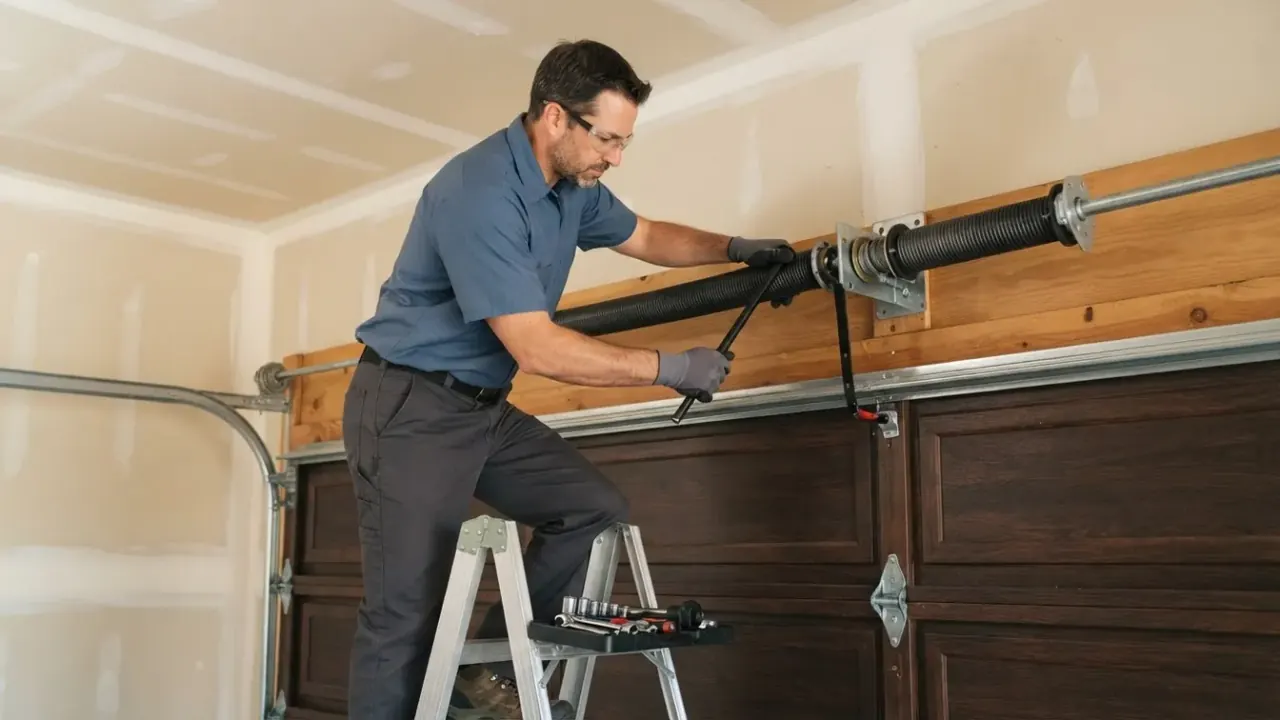
You should replace garage door springs instead of repairing them in almost every case, because a spring that has already broken or stretched past its service limit cannot be safely re-tensioned or patched back to full strength. The only real exception is a single failed spring on a two-spring system where the second spring is still within its rated cycle count and you replace the pair anyway for balance.
Garage door spring replacement in Tampa is a same-day job for our crew, usually finished in 60 to 90 minutes, and it is the single most common repair we run across Hillsborough County. Below we walk through why springs are not a repair item, how to read the warning signs, what 2026 pricing looks like here, and when it is time to stop guessing and call us.
The short answer: replace, do not repair, in almost every case
Garage door spring replacement is the standard fix for a broken, stretched, or noisy torsion spring, and it is the only fix that restores the door to its original lifting capacity. A spring is a wound steel coil under hundreds of pounds of tension. Once the steel fatigues or snaps, there is no weld, clamp, or re-wind that returns it to a safe working state.
We get calls every week from homeowners who found a YouTube video about "re-tensioning" a sagging spring. That advice applies to a spring that has slipped on the shaft, not one that has lost its temper. If the coil is cracked, pitted, or has lost more than about 10 percent of its original arc, replacement is the only safe route.
Why garage door springs are not a repair item
A torsion spring is a consumable part, not a repairable one, and it is engineered to fail after a set number of open-and-close cycles. Standard residential springs are rated for roughly 10,000 cycles. High-cycle springs sold for heavier use run 20,000 to 30,000 cycles. Every cycle removes a little life from the steel.
Here is what that means in real numbers. A household that opens and closes the door four times a day burns through about 1,460 cycles a year. That puts a standard 10,000-cycle spring at roughly seven years of service. A family with two drivers coming and going all day can hit 12 to 15 cycles daily and wear out the same spring in under three years.
You cannot add cycles back to a spring. You can only replace it with one rated for more. That is why we stock both standard and high-cycle springs on our trucks, and why we recommend the high-cycle option for any door in a busy Tampa household.
How do you know if your garage door spring needs to be replaced?
You know a spring needs replacement when the door will not stay open on its own, when you hear a loud bang from the garage, or when you can see a visible gap in the coil. Those three signs cover the vast majority of spring failures we see.
Run through this list before you call anyone:
- Loud bang from the garage. A torsion spring snapping sounds like a gunshot. It usually happens when the door is down, which is why so many people find it broken the next morning.
- Door feels extremely heavy. Disconnect the opener and try to lift the door by hand. A healthy door lifts with one hand. A door with a broken spring will not budge.
- Visible gap in the coil. Look at the spring above the door. A two-inch gap in the winding means the spring has snapped.
- Door opens a few inches and stops. The opener is straining against a load it was never meant to carry.
- Uneven lifting. One side rises faster than the other, which points to a spring that has lost tension.
If you see any of these, stop running the opener. Every cycle on a broken spring drags the cables, rollers, and opener motor through stress they were not built for, and that turns a spring job into a much bigger repair.
The 7-year rule and why Tampa springs age faster
Tampa springs tend to fail faster than the national average because of our heat, humidity, and salt air, and because so many homes here have attached garages that stay hot most of the year. A garage that hits 110 to 120 degrees in July and August cooks the lubricant off the coil and speeds up corrosion.
If your home is within a few miles of the bay, the beaches, or any of the older coastal neighborhoods, salt in the air accelerates rust on the steel. We see springs in those areas fail two to three years earlier than identical springs inland. If your door was installed before 2019 and has never had a spring change, you are on borrowed time.
We also see a lot of 1990s and early-2000s construction in neighborhoods like Westchase, Carrollwood, and Town 'N' Country where the original builder-grade springs are still in place. Those doors are past 20,000 cycles in many cases. If you are not sure of the age, we can measure coil diameter and wire size on site and tell you exactly where you stand.
Repair vs replace: what it actually costs in Tampa in 2026
Replacing both torsion springs on a standard two-car door in Tampa runs $250 to $450 in 2026, including labor, and that is the honest number for a same-day job with quality springs. A single-spring door runs $180 to $300.
There is no meaningful "repair" price to compare it to, because a snapped spring cannot be repaired. The only cheaper option is replacing one spring instead of the pair, and we do not recommend it. When one spring of a matched pair breaks, the other has absorbed the same cycles and is usually within weeks or months of failing too. Replacing both at once costs about $60 to $100 more than a single spring and saves you a second service call.
High-cycle springs, rated for 20,000 to 30,000 cycles, add roughly $80 to $150 to the job. For a busy household, that is the better long-term buy. We quote the price before we start, and the number we say is the number you pay.
If the spring failure has already damaged the cables or bent a track, that is a separate repair. You can read about our garage door cable repair in Tampa service for what that involves, but in most cases the cables survive a spring snap just fine.
What to watch out for when a spring breaks
The biggest mistake homeowners make after a spring snaps is continuing to run the opener, and the second biggest is trying to fix it themselves. Torsion springs store enough energy to break bones. We have seen garage doors come down on people who thought they could hold the door up while they worked.
Other things to avoid:
- Do not use the emergency release and lift the door by hand. A door with a broken spring weighs 150 to 250 pounds. It will come down hard.
- Do not buy a spring off a big-box shelf and match it by length. Springs are matched by wire gauge, inside diameter, and coil count. A wrong spring will fail early or overload the opener.
- Do not replace just one spring on a two-spring door. The door will lift unevenly and wear the tracks and rollers.
- Do not ignore a second bang a few weeks later. That is the matched spring failing, exactly as expected.
If you hear a bang, shut the door if it is safe, unplug the opener, and leave the door down until we get there. That one step prevents most of the secondary damage we see.
When to call a professional
Call a professional the moment you suspect a spring problem, because there is no safe DIY path through a torsion spring job. The tools alone - winding bars, a proper winding cone, and a calibrated torque check - are not something most homeowners own, and the injury risk is real.
Our team at garage door repairs Tampa Fl handles spring replacement, cable work, and full door service across Tampa and the surrounding Hillsborough County neighborhoods. We carry both standard and high-cycle springs on the truck, so most jobs are done in one visit. If the spring failure has also thrown the door off its track, we can handle that on the same call.
If you want to know what routine care looks like to get more years out of a new spring, our garage door maintenance in Tampa service covers lubrication, balance checks, and hardware inspection twice a year.
Frequently Asked Questions
How long do garage door springs last in Tampa?
Standard 10,000-cycle springs last about seven years in a typical Tampa household, and often five to six years in coastal or high-use homes. High-cycle springs rated for 20,000 to 30,000 cycles can last 12 to 20 years. Heat, humidity, and salt air all shorten that window.
Can I replace just one garage door spring?
You can, but we do not recommend it. On a two-spring door, both springs have absorbed the same cycles, so the second one is usually close to failing. Replacing the pair costs $60 to $100 more and avoids a second service call within a year.
How much does garage door spring replacement cost in Tampa in 2026?
Expect $250 to $450 for both torsion springs on a standard two-car door, including labor. A single-spring door runs $180 to $300. High-cycle springs add $80 to $150. We quote the exact price before we start.
Is it safe to use my garage door with a broken spring?
No. A door with a broken spring weighs 150 to 250 pounds and can fall without warning. Unplug the opener, keep the door down, and do not try to lift it by hand. Call us and we will be out the same day in most cases.
Do I need to replace both springs if only one is broken?
Yes, in almost every case. Matched springs wear at the same rate, so the surviving spring is usually weeks or months from failing. Replacing both at once keeps the door balanced and saves you a second visit.
Get help with garage door repair in Tampa
If your door banged, sagged, or stopped lifting, the spring is almost certainly the cause, and we can have it replaced the same day. Call us at +17739156384 and we will get your door moving again.