How Tampa humidity and storms affect your garage door
Salt air, 90% summer humidity, and storm-driven rain destroy Tampa garage doors from the inside out. Here is what fails first and what it costs to fix in 2026.
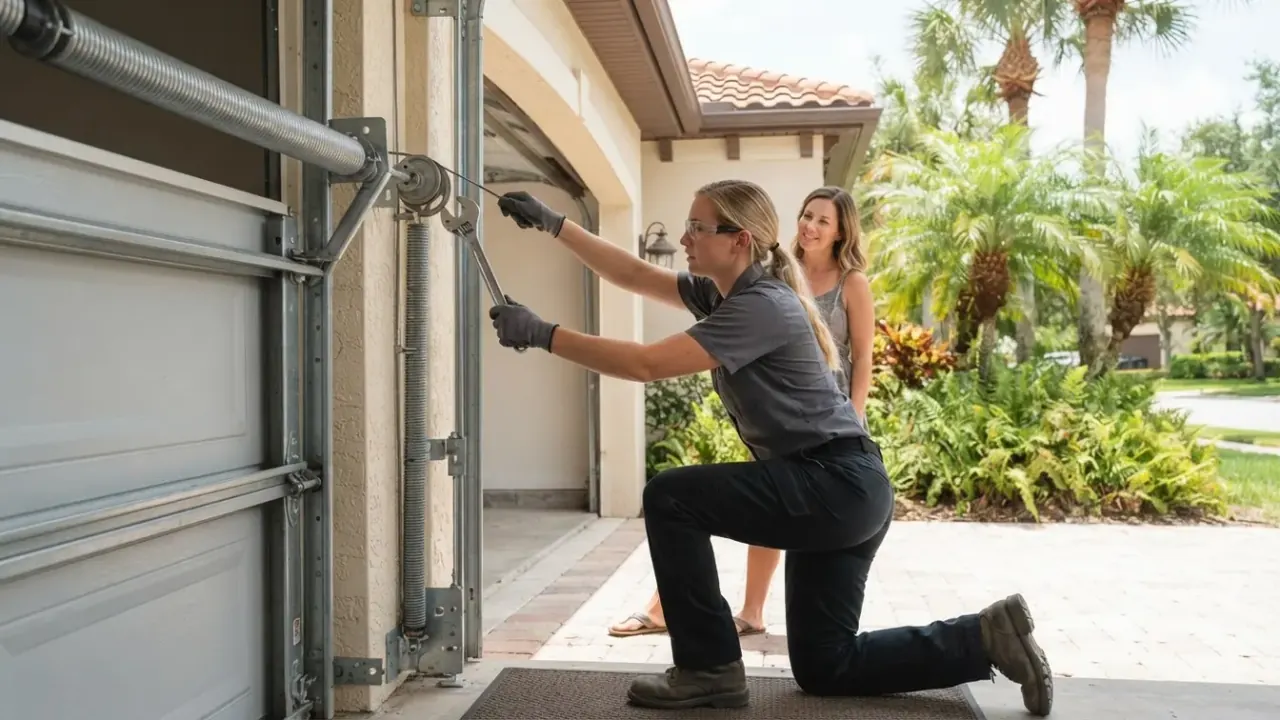
Tampa's humidity and storms destroy garage doors faster than almost any other climate in the country, because salt air, 90% summer humidity, and wind-driven rain attack the steel, wood, and hardware from the inside out. The damage starts small - a rust bloom on a hinge, a panel that swells a sixteenth of an inch - and by the time the door is loud, crooked, or stuck, you are looking at a repair bill instead of a maintenance visit. This post breaks down exactly what fails first, what it costs to fix in 2026, and how to keep your door working through another storm season.
What Tampa humidity and storms actually do to a garage door
Garage door repair in Tampa is a different trade than it is in drier markets. The average relative humidity here sits above 70% for most of the year, and from June through September it regularly climbs past 90% overnight. That moisture does not just sit on the surface - it works into every seam, weld, and roller track on the door.
Add salt from the bay and the Gulf, and you have an environment that eats galvanized hardware in roughly half the time it would take in Orlando or Ocala. A door that would last 15 years inland often needs its first major repair at year eight or nine here.
Storms add the second punch. Tampa Bay averages around 50 thunderstorm days a year, and hurricane season runs June 1 through November 30. Every one of those storms drives rain sideways into the door, and the wind pressure flexes panels that were never designed to move.
Why does my garage door rust and swell in Tampa?
Rust and swelling happen because moisture never fully dries out of the door in Tampa's climate. Steel doors rust from the bottom up, where water pools on the bottom section and inside the bottom bracket. Wood doors absorb humidity through the end grain and the unpainted edges, then swell and bind against the jamb.
You will usually see the first signs in three places:
- Bottom section and bottom bracket - orange streaks, bubbling paint, or a chalky white residue along the bottom seal.
- Hinges and roller stems - rust dust on the track and a gritty feel when the door moves.
- Panel seams - paint peeling along the stamped lines, which is where water sits longest.
Once rust reaches the bottom bracket, the door is no longer just cosmetic. That bracket carries the full weight of the bottom section, and a rusted bracket can tear out of the panel under load. If you catch it early, a Tampa garage door panel repair is a same-day job. If you wait, you are replacing the whole bottom section.
How storm season knocks doors off track and bends panels
Storm damage in Tampa almost always shows up as one of four problems: a door off track, a bent track, a dented or creased panel, or a snapped cable. Wind pressure is the main culprit. A 60 mph gust against a 16-foot-wide door puts hundreds of pounds of lateral force on panels and tracks that are only designed to carry vertical weight.
When the door flexes, the rollers pop out of the track. When the rollers pop, the door drops on one side, and the cable on that side either kinks or snaps. That is the sequence we see after nearly every named storm that brushes Tampa Bay.
If your door is sitting crooked in the opening, do not run the opener. Call for garage door off track repair in Tampa and leave the door where it is. Running a crooked door chews up the track, bends the hinges, and can drop the door on whatever is parked underneath.
The parts that fail first in Tampa's climate
Every part on a garage door wears out eventually, but in Tampa the failure order is predictable. Here is what we replace most often, roughly in the order it fails.
- Bottom seals and weatherstripping - 3 to 5 years. UV and constant moisture crack the rubber, and once it cracks, water gets behind the door.
- Rollers - 5 to 7 years. Nylon rollers get flat spots; steel rollers rust and seize. A noisy garage door roller repair Tampa visit usually fixes the grinding sound in under an hour.
- Hinges - 6 to 9 years. The bottom hinge rusts first because it sits closest to the wet slab.
- Cables - 7 to 10 years. Rust works into the strands, and the cable fails at the loop or the drum.
- Torsion springs - 7 to 12 years. Tampa springs cycle more often than inland springs because doors here get opened and closed more, and humidity accelerates corrosion on the coils.
- Panels - 10 to 15 years. Dents, rust-through, and swelling usually mean replacement rather than repair.
Springs deserve their own note. A torsion spring in Tampa typically lasts 7 to 12 years, compared to 10 to 15 in drier parts of Florida. When one breaks, it sounds like a gunshot in the garage, and the door will not lift. That is a job for torsion spring repair Tampa - never a DIY job, because the springs are under enough tension to break a wrist.
What it costs to fix storm and humidity damage in 2026
Typical 2026 pricing in the Tampa area breaks down like this. These are real ranges we quote, not national averages pulled from a directory.
- Roller replacement (full set): $120 to $220 installed.
- Hinge replacement (full set): $150 to $280.
- Cable replacement (one side): $180 to $320.
- Torsion spring replacement (both springs): $350 to $650, depending on door weight and spring size.
- Panel replacement (single section): $400 to $900, plus paint match.
- Track replacement (one side): $250 to $500.
- Off-track reset with new rollers: $200 to $400.
- Full door replacement: $1,400 to $3,500 for a standard two-car door, installed.
Humidity damage tends to hit in clusters. A rusted bottom bracket usually comes with a cracked bottom seal and two or three seized rollers, so the visit is rarely just one part. We quote the whole repair up front before we touch the door, so there are no surprises when the work is done.
Common mistakes Tampa homeowners make after a storm
The most expensive mistake is running the opener on a door that is already crooked or jammed. The motor does not know the door is off track - it just keeps pulling until something bends or snaps. That turns a $250 reset into a $700 track-and-cable job.
Other mistakes we see every storm season:
- Spraying WD-40 on the springs and track. WD-40 attracts grit. Use a proper garage door lubricant on hinges, rollers, and springs - never on the track surface itself.
- Patching rust with spray paint. Paint over active rust traps moisture and speeds up the corrosion underneath.
- Ignoring a door that reverses for no reason. After heavy rain, a misaligned safety sensor is the usual cause, and a safety sensor repair Tampa visit is quick and cheap compared to a door that closes on a car.
- Waiting until the door will not open at all. By then you are paying emergency rates and possibly replacing panels you could have saved.
When to call a professional
Call us when the door is crooked, when a cable is hanging loose, when you hear a bang from the spring tube, or when the door will not stay closed after a storm. Those are the four situations where a DIY fix turns into a bigger repair.
We also recommend a professional inspection once a year, ideally in April or May before storm season starts. Our team at garage door repairs Tampa Fl checks the springs, cables, rollers, hinges, bottom seal, and safety sensors in about 45 minutes, and we lubricate everything that needs it. If you would rather have us handle the whole thing, we offer garage door maintenance in Tampa on an annual schedule so nothing gets missed.
If you are in South Tampa, Westchase, or anywhere along the bay where salt air is heaviest, plan on that inspection every year without exception. Doors in those neighborhoods rust noticeably faster than doors in Brandon or Wesley Chapel.
Frequently Asked Questions
How often should I lubricate my garage door in Tampa?
Every 4 to 6 months, and always in late spring before storm season. Tampa's humidity dries out lubricant faster than dry climates do, so twice a year is the minimum. Use a lithium-based or silicone garage door lubricant on hinges, rollers, and the spring coils - not on the track.
Can humidity really bend a garage door?
Yes, wood doors swell and warp, and steel doors flex at the seams once rust weakens the panel. A door that swells by a quarter inch can bind against the jamb and stop opening. If your door sticks in summer and works fine in winter, humidity is the cause.
My door came off track after a storm. Can I fix it myself?
No. A door that is off track is under load and can drop without warning. Call for off-track repair and leave the door in place. Most off-track resets in Tampa take 60 to 90 minutes once we are on site.
How long do garage door springs last in Tampa?
Seven to twelve years, compared to ten to fifteen inland. The shorter life comes from higher cycle counts and corrosion on the coils. If your door is over eight years old and the springs have never been replaced, have them checked before storm season.
Does homeowners insurance cover storm damage to a garage door?
Usually yes, if the damage came from a named storm or a falling limb. Wind-driven rain damage is often covered; rust and long-term humidity damage usually is not. Photograph the damage before you touch anything and call your insurer first.
Get help with garage door repair in tampa
If your door is rusted, crooked, or making noise after the last storm, we can take a look this week. We handle everything from a single hinge to a full door replacement, and we quote the price before we start.
Call garage door repairs Tampa Fl at +17739156384 and we will get your door moving smoothly again.